 Sunday Reading
Three of the Eight Numbers on the Back of This Bottle Match Their TrialsThorne's Memoractiv is the best-scored bottle that has reached this desk: 4.6 from 79 buyers, every one of them carrying the store's own purchase mark. I read all eight lines beside the trials that tested them, counted the caffeine the two capsules carry, and read the sixty-day return terms with their quarter taken off.
Memoractiv is a bottle of sixty capsules from Thorne, a South Carolina company, taken two at a time and away from bedtime, and its panel prints eight lines with a milligram figure beside each one. Three of those figures land on the number their trial used, one lands at a third of it, one doesn't say how much of the plant is inside the complex, and two have no trial I can hand you at all.

This is a paid advertisement. Sponsored by Thorne Research, Inc.

Harlan Voss is the pen name of this desk.
Everything on this page about the bottle comes from the maker's own product listing, the panel printed on it and its published return terms, all read on September 20, 2026.
The four customer reviews quoted below are real and carry the store's own purchase mark; the small portraits beside them are illustrations, not the reviewers.
Most Sunday mornings I read a label the way other people read box scores.
This one took longer than usual, and not because it was badly written.
It took longer because the numbers are mostly real, and real numbers are slower to check than vague ones.
A panel that says "proprietary blend, 1,470 mg" can be read in four seconds, because there is nothing in it to read.
This panel prints eight lines, and every one of them has a milligram figure beside it.
That's rarer on this desk than you'd think, and it's the reason this bottle got a full morning instead of ten minutes.
Eight lines, eight numbers. Three of them land where their trial landed.
Memoractiv is made by Thorne, a supplement company in Summerville, South Carolina, with a street address, a phone number that answers on weekdays and its own manufacturing.
It comes as sixty capsules in a white bottle, taken two at a time.
By the maker's own rating, it is the best-received bottle I have looked at: 4.6 from 79 buyers, each review carrying the store's own purchase mark.
That is a real signal about satisfaction and it is not a signal about anything else, which is a distinction this page will keep making.
A high score tells you people liked what arrived. It does not tell you what any line on the panel did.
So here is the morning's work, in order.
The bottle and the rule about bedtime, then the score and the four people who wrote in.
Then the eight lines, one at a time, each beside the trial that tested that ingredient and at what dose.
Then the two things the listing does not put in its first paragraph: the caffeine these capsules carry, and the one line I'd name at the pharmacy counter before the first serving.
What I found is three lines at trial dose, one at a third of it, one complex that doesn't say how much plant is inside it, two with no trial I can hand you, 50 milligrams of caffeine in a capsule, and sixty days to send it back minus a quarter.
One more thing before the first reading, because most of you got here from one of our own advertisements.
Those advertisements talk about a boxed cereal, three foods, three drinks, and three words or phrases a man is supposed to be able to say.
None of that is in this bottle, and I won't pretend it is.
It's on this page, in its place: the eleventh reading, with the studies, and the honest version of every headline we run is in the guide linked at the foot.
Reading one · The bottleSixty Capsules, Two to a Serving, Thirty Servings, and a Line About Bedtime
This is what arrives.
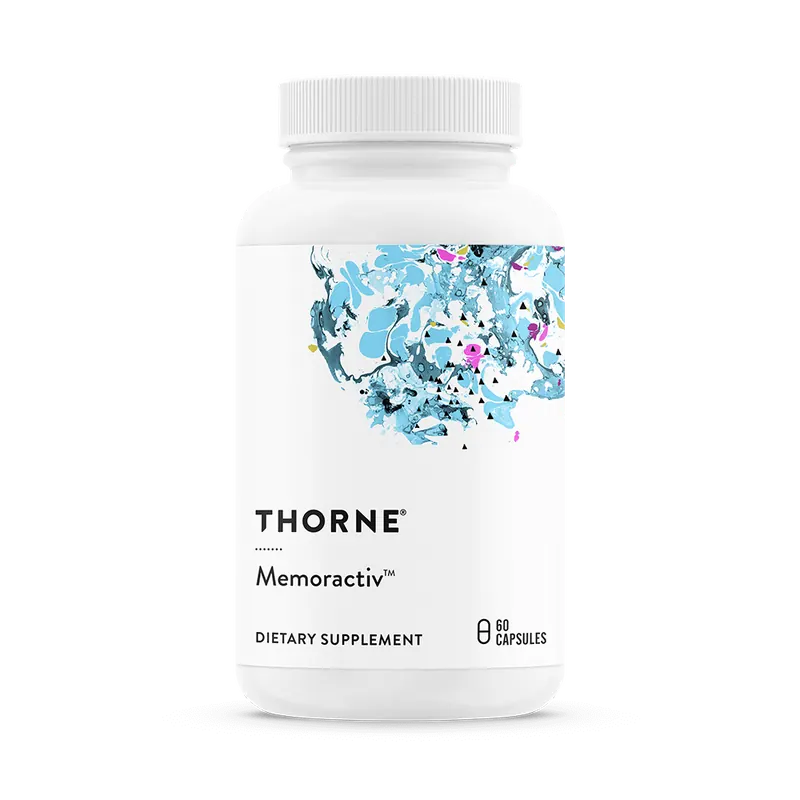
A white bottle of sixty capsules, in hypromellose, which is a cellulose shell rather than gelatin.
The listing gives the length of one capsule as 23.3 millimetres, which is nine tenths of an inch.
That matters more than it sounds.
Two capsules almost an inch long, swallowed together, is the whole serving, and some people will find that a lot to take at once.
The direction is short.
Take two capsules one to two times a day, away from bedtime, or as your own clinician advises.
Read the arithmetic in that sentence.
One serving a day makes a bottle last thirty days; two servings a day makes it last fifteen.
The printed cautions add four more lines, and they are the plainest part of the label.
Don't use it if you're sensitive to any ingredient; don't use it while pregnant, nursing or trying to conceive; ask your clinician first if you take something daily that thins the blood; and there is a caffeine notice, because the capsules carry caffeine.
Two capsules, away from bedtime. Fifteen or thirty days to the bottle.
Reading two · The scoreFour Point Six From Seventy-Nine Buyers, and the Four Who Wrote Something Worth Quoting
Before the panel, the part most people read first.
The listing shows 4.6 from 79 written reviews: sixty-three at five stars, seven at four, three at three, two at two and four at one.
Every one of them carries the store's own purchase mark, which means the store matched the review to an order.
That is a better-documented set of reviews than most listings on this desk manage, and it still isn't evidence about your memory.
It's evidence that seventy-nine people bought a bottle and most of them were content.
I read the first page of them and pulled the four that said something specific enough to be worth your time.
Two I left out: one was about a parcel that never arrived, which is a shipping story, and one was four words long.
Here they are as written, with the store's purchase mark, and with illustrated portraits rather than photographs of the writers.

I have been trying various supplements to enhance my cognitive function and memory. This one seems to be helping. I take it in the morning and it helps me get started and thinking clearly throughout the day.

I have been using them for almost 4 weeks, I believe they help me focus on my tasks.

Great way to get focused on those busy days. I was having issues with feeling overwhelmed and trying to stay on track with daily tasks because of the emergencies that would come flying out of nowhere.

Love it and it really helps and works.
Read those the way I do.
John says "seems to be helping," and he says he takes it in the morning.
Iman says "almost 4 weeks" and "I believe."
Jared is describing a busy week at work, not a memory.
Every one of those sentences is about the first hours of a morning, and there are 50 milligrams of caffeine in the serving.
I'd hold that thought until the fifth reading.
Seventy-nine buyers, 4.6, and four careful sentences. A good score, honestly documented, about how people felt, not about what the panel did.
Reading three · The ashwagandhaThree Hundred Milligrams of KSM-66, Which Is Exactly the Amount of Its Trial
The first of the three lines that land where their trial landed.
Ashwagandha is a root from an Indian shrub, used in Ayurvedic practice for a very long time.
The version here is KSM-66, a branded root extract, at 300 milligrams per serving.
There is a trial at exactly that figure.
A hundred and twenty-five adults aged 20 to 55 took 300 milligrams a day of a sustained-release root extract for ninety days, and the extract group scored better on memory and focus measures than the placebo group. [1]
Ninety days is a long run for a botanical trial, and 125 people is a respectable number for one.
Two honest limits: the participants were 20 to 55, which is younger than the man this page is written for, and the trial recruited people whose days were demanding rather than a general sample. [1]
A second, smaller study used a different form.
Fifty-nine young adults, average age 23, took 225 milligrams a day of a liposomal root-and-leaf extract for thirty days and did better on some word-recall and reaction measures than placebo. [2]
That one is in people less than half the age of this page's reader, in a different preparation, so I count it as background rather than support.
The 300-milligram line is the one that matters, and this bottle prints exactly 300.
Ashwagandha at 300 milligrams, the dose of a ninety-day trial in 125 adults aged 20 to 55. The clearest match on this panel.
Reading four · The two pigmentsTwelve Milligrams of Lutein and Zeaxanthin, the Figure Two One-Year Trials Used
The second line that lands on its number, and the one most people skip because it sounds like an eye supplement.

Lutein and zeaxanthin are the yellow pigments that sit in the centre of the retina, and they come from marigold, kale, spinach and egg yolk.
This panel prints 10 milligrams of lutein and 2 of zeaxanthin, which is 12 together.
Twelve is the number two one-year trials used.
In the first, sixty-two adults living at home, average age 74, took 12 milligrams a day for a year; the pigment levels in their retinas rose and they did better than placebo on measures of complex attention and mental flexibility. [3]
The second gave 12 milligrams a day for a year to forty-four adults averaging 72, and the supplement group held their ground on a word-learning task while the placebo group slipped. [4]
The authors' own phrase was that it "appeared to buffer" the change, which is the careful way to say it, and it's how I'll say it too. [4]
A third trial is worth knowing because it shows the company it usually keeps.
Sixty adults over 65 took a daily combination of fish oil, 22 milligrams of carotenoids and vitamin E for two years and made fewer errors on working-memory tasks than placebo, with small effects that grew as the tasks got harder. [5]
Two one-year trials, fifty-one and forty-four people analysed, both at 12 milligrams, and this bottle prints 12 milligrams.
That is the second honest match on the panel, and the studies behind it are small.
One thing the listing says that the panel doesn't quite support.
The description says the branded pigment blend supplies meso-zeaxanthin as well, and the printed panel lists only lutein and zeaxanthin, with no figure for a third pigment.
Lutein and zeaxanthin at 12 milligrams, the figure of two one-year trials in adults averaging 72 and 74. Small trials, right number.
Reading five · The caffeineFifty Milligrams in a Capsule, Which Is Half a Cup of Coffee, and the Label Says So
The third match, and the one the listing does not put in its opening paragraph.
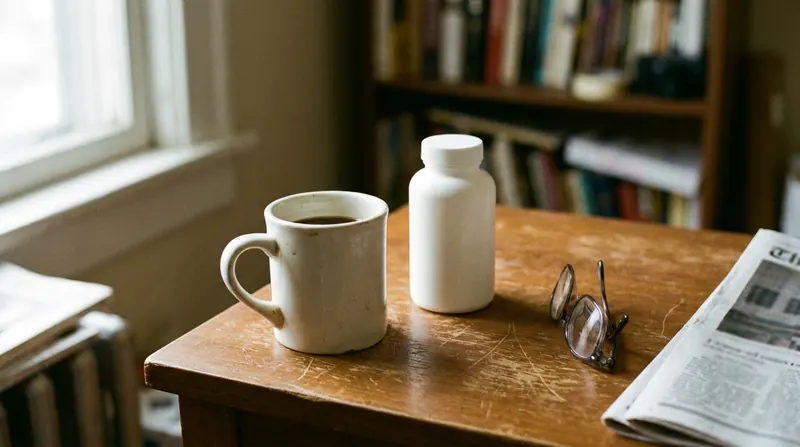
The panel prints 50 milligrams of caffeine per serving, and the printed cautions carry a caffeine notice.
It arrives as part of a co-crystal, a form in which caffeine and trans-pterostilbene are bonded together, which the maker says releases more slowly than caffeine on its own.
Fifty milligrams is a real dose and a modest one.
The Food and Drug Administration puts a 12-ounce cup of brewed coffee anywhere from 113 to 247 milligrams, and cites 400 milligrams a day as an amount not generally tied to negative effects in most healthy adults. [6]
Europe's food safety agency reached the same 400-milligram daily figure, and 200 for a single serving. [7]
It also says caffeine in moderate amounts makes people more alert and less sleepy, which is the one effect on this panel nobody argues about. [7]
It is about half a mug. Count it with your coffee, not instead of it.
Now run the arithmetic the label allows.
Two servings a day, which the direction permits, is 100 milligrams of caffeine on top of whatever is in your cup.
The same agency lists what too much caffeine brings: a faster heartbeat, the jitters, an upset stomach, a headache and a poor night. [6]
That is why the label says away from bedtime, and why I'd take this bottle in the morning or not at all.
It also explains something about the reviews.
Four people wrote about getting started in the morning and staying on track through a busy day, and 50 milligrams of caffeine is the line on this panel most likely to be doing that work.
Fifty milligrams of caffeine, half a mug, with a real short-lived effect on alertness and a notice on the label. Honest, and not the line the advertisement sells.
Reading six · The bacopaA Hundred Milligrams of Bacopa, Against the Three Hundred of Its Trials
The first line that falls short of its number, and it falls short by two thirds.

Bacopa monnieri is a creeping marsh herb from India, standardised here to 20 per cent bacosides, at 100 milligrams per serving.
Its trials are among the better ones in this whole field, and they all used 300.
In the first, fifty-four adults aged 65 and over took 300 milligrams a day for twelve weeks; forty-eight finished, and they recalled a delayed word list better and did better at ignoring irrelevant information than the placebo group. [8]
Nothing moved on divided attention or immediate working memory, and the commonest complaint was an upset stomach. [8]
In the second, ninety-eight adults over 55 took 300 milligrams a day for twelve weeks; eighty-one finished, and verbal learning and delayed recall came out ahead of placebo. [9]
Other attention measures didn't differ, and the extract group reported more cramps, nausea and trips to the bathroom. [9]
A 2014 pooled analysis of nine placebo-controlled trials, 518 people in total, all at twelve weeks or longer, found faster performance on two measures of attention speed and asked for a large well-designed trial to settle it. [10]
The differences there were measured in milliseconds. [10]
So the ingredient has the best paper trail on this panel, and this bottle carries a third of the amount that produced it.
At two servings a day, the label's upper direction, you reach 200 milligrams, which is still short.
Bacopa at 100 milligrams against the 300 a day of every trial worth citing, in adults 55 and over. Right plant, third of the dose.
Reading seven · The ginkgo complexTwo Hundred Forty Milligrams of a Complex, and No Figure for How Much Leaf Is Inside It
The line that has a number without telling you what the number counts.

The panel prints 240 milligrams of Ginkgo Phytosome, a branded complex of ginkgo leaf extract bound to sunflower phospholipids.
The maker's case is that binding it to a fat carrier gets more of it absorbed, which is a reasonable thing to build.
Here is the problem with reading it.
Two hundred and forty milligrams of a complex is not 240 milligrams of ginkgo extract, and the label prints no figure for how much leaf extract the complex holds.
Without that figure I can't set this line beside its trials, and the trials are worth knowing either way.
The largest one gave 3,069 adults aged 72 to 96 either 120 milligrams of a standardised ginkgo extract twice a day or placebo, followed them a median of six years, and found no difference in memory, attention, language or executive function. [11]
A smaller and more favourable one gave ninety-three adults aged 55 to 79 120 milligrams a day for twelve weeks and found a moderate advantage on one associational-learning measure, and nothing statistically meaningful on any other cognitive, attention or executive measure it took. [12]
One positive result among many measures is a thin thing to build on, and the authors said so. [12]
The federal government's centre for complementary health puts it plainly: there is no conclusive evidence that ginkgo helps any health condition. [13]
The same page says ginkgo may raise the risk of bleeding in people who take something daily to thin the blood. [13]
That is the line I would name at the pharmacy counter before the first serving, and the label names it too.
The printed cautions ask you to consult your own clinician if you take something daily that thins the blood, because of the ginkgo. [13]
A 240-milligram complex with no figure for the leaf extract inside it, from a plant whose largest trial in 3,069 older adults came out even. The one line to take to the pharmacist.
Reading eight · The other twoTwo Hundred Fifty Milligrams of Carnitine and Sixty-Six of Pterostilbene, With No Trial I Can Hand You
The last two lines on the panel, and the shortest section on this page, because there is little to say honestly.
Acetyl-L-carnitine, at 250 milligrams, is a form of a compound your body already makes and uses to move fat into the cell's furnaces.
The maker's own description is that it matters for cellular energy production and nerve function, which is a description of biology rather than a result.
I have no trial on this desk that tested 250 milligrams of it in healthy adults over 55 and measured their memory.
So I won't dress it up. It is a real compound at a small dose, with nothing behind it I can hand you.
Trans-pterostilbene, at 66 milligrams, is the other half of the caffeine co-crystal, and it is a compound found in blueberries and related to resveratrol.
Its relative has been tested: forty-six overweight adults aged 50 to 75 took 200 milligrams of resveratrol a day for twenty-six weeks and retained words over thirty minutes better than placebo. [14]
That study is not this ingredient and not this dose.
Pterostilbene is on this panel as the other half of the caffeine, and the fair reading is that the caffeine is what it brought with it.
Carnitine and pterostilbene: real compounds, printed amounts, and no trial at these doses I can put in front of you. Two of the eight.
Reading nine · Six or eightThe Listing Says Six Ingredients, the Panel Prints Eight Lines, and the Audience Keeps Changing
Three small things that a careful reader will spot, and that I'd rather tell you than leave.
The first is a count.
The description says six studied botanicals and nutrients; the panel prints eight lines, because the caffeine and the pterostilbene arrive in one co-crystal and the lutein and zeaxanthin in one extract.
Neither number is a lie, and I'd still print eight, because eight is what you swallow.
The second is the meso-zeaxanthin in the description with no line on the panel, which I covered in the fourth reading.
The third is the audience.
The same listing describes this bottle for people in their twenties and thirties, for gamers, for students, and for aging baby boomers who want to maintain mental agility.*
A formula addressed to a twenty-five-year-old at a screen and to a sixty-eight-year-old at a desk is doing one of two things.
Either the maker believes the same panel serves both, which is a position, or the copy is written to be bought by everyone, which is a habit.
There is one word in that listing I won't reprint, the category word the maker uses for this kind of formula.
Our advertising rules don't allow it, and I think that is the right rule, because it promises a category rather than describing a bottle.

Reading ten · The return termsSixty Days to Send It Back, With a Quarter of It Kept
The part of a listing I read before I read anything about the ingredients.
The maker's published terms say you may request a return within sixty days of the date of purchase, and that approved returns carry a 25 per cent restocking fee.
Customer service takes the request on 1-800-228-1966, weekdays.
Read what that means with a pencil.
Sixty days is a generous window and a quarter is a real deduction, so a bottle you open and dislike costs you a quarter of it plus whatever the return carriage costs.
I say that without complaint, because both halves are printed in plain sight.
A company that prints the restocking figure is easier to deal with than one that prints a warm sentence and puts the figure three pages down.
Here is how I would use the window.
Sixty days is exactly two bottles at one serving a day, which is enough time to know whether you are getting anything and to return the second unopened if you're not.
Two bottles, sixty days, and a quarter kept if you send one back.
Reading eleven · The bowl and the cupThe Cereal, the Three Drinks, the Three Foods and the Word Test From Our Own Advertisements
If you arrived from one of our advertisements, this is the section you were promised.
The cereal first.
No cereal "ages the brain faster than time," nobody has measured any such thing, and that phrase was written to be clicked.
What the research says is duller and worth more.
In a Brazilian study of 10,775 adults followed for eight years, the people who ate the most ultra-processed food slipped on thinking tests about a quarter faster than the people who ate the least. [15]
That is an association across a population, not a sentence about your bowl.
Plain oats, plain shredded wheat and the sugar figure on the side of the box are the whole of the useful advice there.
The three drinks.
The "evening drink" in our advertisement is alcohol, and it has the strongest case behind it of anything our advertisements point at.
In 550 British civil servants followed for thirty years, the more a person drank the faster their word-fluency scores fell, and light drinkers had no edge over people who didn't drink at all. [16]
The second drink is sugar in a glass, which sits on the same ultra-processed shelf as the sweet cereal. [15]
The third, in one of our headlines, was coffee.
That was our worst headline, and I'll say so in the same sentence in which I tell you this bottle carries half a mug of it.
Plain black coffee and plain tea are not the drinks any of those studies were about.
Keep your coffee, and count this bottle's 50 milligrams along with it. [6]
The three foods.
Processed meat, fried food and the white-flour shelf: pastries, packaged cakes, white bread.
Our advertisement says "just stop eating these three," and the research says something slower.
In a three-year trial of 604 older adults, one group ate the MIND pattern of vegetables, berries, nuts, whole grains, beans, fish and olive oil while the other ate its usual food with a few calories less, and both groups' thinking scores rose by about the same amount. [17]
That is a pattern over years, not a list of three, and even the pattern built for it did not beat plain care with what you eat. [17]
One more worth a line: in the Framingham families, people whose food carried more choline, which is eggs, milk, meat and beans, scored better on memory tests than those whose food carried less. [18]
Less sugar in the bowl and the glass.
Less alcohol in the evening.
Keep the coffee.
Eat more like the Mediterranean shelf and less like the vending machine.
The three words, or the three phrases.
There is no such list.
What our advertisement borrowed from is the short scored mental-status check a clinician gives in person: the date and the place, a few words to hold and give back a minute later, a sum, naming, copying a drawing.
It's read against your age and your schooling by someone trained to do it, and a low score is a reason for a proper look, not a verdict.
Stumbling on a word when you're tired or being timed means nothing on its own.
If the worry behind the click is real, that's fifteen minutes with your own clinician.
And the advertisement about the things some men take every day.
That one sits closest to real research, and it is the one an advertisement has no business acting on.
Some kinds of daily medicine, a few of them sold over the counter, are on the lists pharmacists check for people over 65.
Don't stop or change any of it because of an advertisement, ours included.
Put everything you take in one bag, this bottle included, and take it to the pharmacist.
Ask one question: is anything here a poor choice at my age, and does anything here argue with the ginkgo line on this panel?
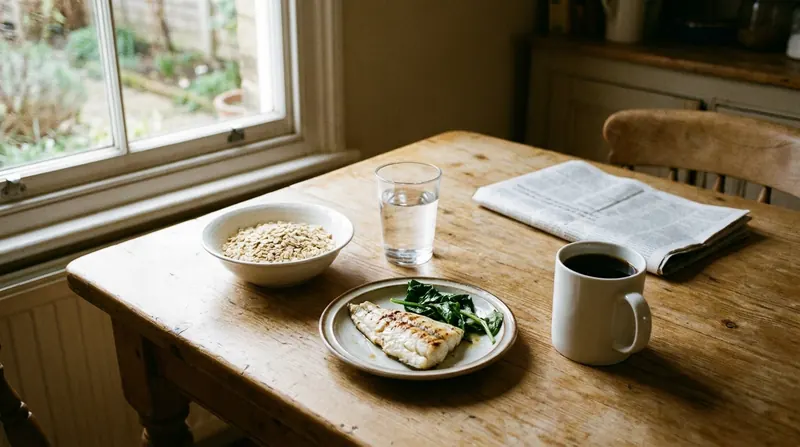
So if you clicked on the cereal, here's where it went: onto a desk beside a white bottle, where the real answer was always a plainer bowl, a fillet of fish, and the coffee you already had.
Reading twelve · What it isn'tSeven Things a Bottle of Sixty Capsules Won't Do
- It won't come with a trial of itself. No study has tested this formula; the trials above tested single ingredients in other people.
- It won't bring the bacopa to its trial dose. A hundred milligrams against 300 a day, and 200 at the label's upper direction.
- It won't tell you how much ginkgo leaf extract is in the complex. The panel prints the complex, not the leaf.
- It won't replace the alertness of your coffee with something stronger. Fifty milligrams is half a mug, and it is in the serving.
- It won't act on any condition a clinician has named. It is a dietary supplement, and its label carries the sentence that says so.
- It won't settle the interaction question for you. That is the pharmacist's two minutes, before the first serving.
- It won't come back at full price if you dislike it. Sixty days to ask, and a quarter kept on approved returns.
If that list annoys you, I'd rather you were annoyed now than on the thirtieth morning with an empty bottle and no idea which line did anything.
Reading thirteen · The routineIf You Do Buy It: One Bottle, the Pharmacist First, Mornings Only, and a Notebook
If you're going to try it, try it as a test with a date on it.
- Buy one bottle of sixty. At one serving a day that is thirty mornings, and thirty mornings is a fair test.
- Take the bottle to the pharmacist before the first serving, with everything else you take. Ask about the ginkgo line by name.
- Keep it to one serving a day unless a clinician tells you otherwise. Two servings doubles the caffeine to 100 milligrams.
- Take it in the morning, away from bedtime. The label asks for that, and the caffeine is the reason.
- Count the 50 milligrams with your coffee. Not instead of it, and not on top of a third mug.
- Write one line a day in a notebook. Not "sharper" or "foggier," but what you were doing at ten and how it went.
- On the thirtieth morning, read your thirty lines beside the thirty from the month before. That's the only trial of this bottle you'll ever get.
Look at that list the way I do.
Six of the seven things cost nothing at all.
This is worth a look if:
- You want a panel where every line has a milligram figure beside it, and you'll read them.
- You like that three of the eight land on the number their trial used, and you accept that two have nothing behind them.
- You'll take the bottle to the pharmacist before the first serving and ask about the ginkgo.
- You'll keep it to the morning and count its caffeine with your coffee.
Give it a miss if:
- You take something daily that thins the blood, until the pharmacist has seen the bottle.
- You're sensitive to caffeine, or you already drink three mugs before noon.
- You want the bacopa at the dose of its trials. This is a third of it.
- You find a capsule nine tenths of an inch long hard to swallow, twice at a time.
Reading fourteen · Who sells itA South Carolina Company With a Street Address, a Weekday Phone Line and Its Own Panel
The bottle is sold by the company that makes it, and that's the only place this page links to.
Thorne Research, Inc. publishes a street address in Summerville, South Carolina, a support email and a phone line that answers on weekdays between eight in the morning and eight at night, Eastern time.
The label says the bottle is manufactured in the USA using US and imported ingredients.
The price is the one on the maker's listing on the day you look, and this page prints none.
Look at it before you click, and look at the return terms in the tenth reading while you're there.

Buy one bottle.
Thirty mornings is a test, and the pharmacist comes first.
Read the panel you get, then read the month you had.
Every line of the panel, with the plain English name, the amount, the trial behind it and who was in that trial, is written out in the ingredient and advertising guide linked at the foot of this page.
It also explains the ginkgo line for the pharmacist, and says which of our own headlines this bottle does and doesn't support.
Where to get it
Two capsules almost an inch long, with ashwagandha, ginkgo, bacopa, the two pigments of the eye and as much caffeine as half a cup of coffee, taken away from bedtime.
CHECK AVAILABILITYSold by Thorne Research, Inc., Summerville, South Carolina · sixty capsules, two to a serving, thirty servings · away from bedtime · 50 mg of caffeine per serving · sixty days to request a return, 25% restocking fee on approved returns
QuestionsWhat Readers Ask Me Before the First Bottle
Questions readers ask
Is this medicine?
No. It is a dietary supplement: sixty capsules with eight printed lines, made and sold by a South Carolina company.
Its label carries the standard sentence every American supplement carries, the one that says the Food and Drug Administration has not evaluated its claims.
How much caffeine is in it?
Fifty milligrams per serving of two capsules, which is about half a 12-ounce cup of brewed coffee; a full cup runs from 113 to 247 milligrams, and 400 a day is the figure the Food and Drug Administration cites for most healthy adults. [6]
The label's upper direction is two servings a day, which would be 100 milligrams, on top of whatever is in your mug.
Will it help my memory?
I can't tell you that, and you should be wary of any page that does. Nobody has tested this formula, and the trials on this page tested single ingredients in other people.
What I can tell you is which lines carry the amount their trial used: the ashwagandha, the two eye pigments and, for alertness, the caffeine. [1] [3] [7]
Which line should I ask the pharmacist about?
The ginkgo. The federal government's centre for complementary health says ginkgo may raise the risk of bleeding in people who take something daily to thin the blood, and the label carries the same caution. [13]
Take the bottle with everything else you take, and ask before the first serving.
Why is the bacopa only 100 milligrams?
I don't know, and the listing doesn't say. Every bacopa trial worth citing used 300 milligrams a day for twelve weeks or more. [8] [9] [10]
Can I take it at night?
The label says away from bedtime, and 50 milligrams of caffeine is the reason. Mornings.
What do the reviews say?
Seventy-nine written reviews averaging 4.6, all carrying the store's own purchase mark, and four of them are quoted in the second reading exactly as written.
Read them as reports of how people felt in the morning, which is what they say, and not as evidence about the panel.
What if I open it and don't like it?
You may request a return within sixty days of purchase, and approved returns carry a 25 per cent restocking fee. Customer service takes the request on 1-800-228-1966 on weekdays.
How long does a bottle last?
Thirty days at one serving, fifteen at two. Sixty capsules, two to a serving.
Your advertisement was about a cereal, or three foods, or three drinks. Where is that on this page?
In the eleventh reading, in full, with the studies. The short version: less sugar in the bowl and the glass, less alcohol in the evening, keep your plain coffee, and eat more like the Mediterranean shelf.
None of it is in the bottle, and the ingredient and advertising guide at the foot goes through every headline we run.
Your advertisement said something about three phrases, or spelling three words. Is there a test I can take?
Not on a screen. The words and phrases come from the short mental-status check a clinician gives in person, read against your age and your schooling.
If the worry behind the click is real, ask your own clinician for the proper check. It takes about fifteen minutes.
The short versionEverything Above, in Sixty Seconds
- A white bottle of sixty capsules from Thorne of Summerville, South Carolina; two capsules to a serving, thirty servings, away from bedtime.
- Ashwagandha: 300 milligrams, exactly the amount of a ninety-day trial in 125 adults aged 20 to 55. [1]
- Lutein and zeaxanthin: 12 milligrams together, the figure of two one-year trials in adults averaging 72 and 74. [3] [4]
- Caffeine: 50 milligrams, about half a mug, with a real short-lived effect on alertness; count it against the 400-milligram daily figure. [6] [7]
- Bacopa: 100 milligrams against the 300 a day of every trial worth citing in adults over 55. [8] [9]
- Ginkgo: a 240-milligram complex with no figure for the leaf extract inside it, from a plant whose 3,069-person trial came out even. [11] Take it to the pharmacist. [13]
- Carnitine and pterostilbene: real compounds at printed amounts, with no trial at these doses to hand you. [14]
- Reviews: 4.6 from 79 buyers, all with the store's purchase mark, four quoted here as written.
- Returns: sixty days to ask, 25 per cent restocking fee on approved returns, weekday phone line.
- The cereal, three drinks, three foods and the word test from our own advertisements are in the eleventh reading: less sugar, less alcohol, keep the coffee, and no test on a screen.
The last lineWhat Eight Printed Numbers Are Actually Worth
Here's the whole morning in one breath.
A panel with a figure beside every line, which is rarer than it should be, and three of those figures landing exactly where their trial landed.
One good ingredient at a third of its dose, one complex that won't tell you what's inside it, and two lines with nothing behind them I can hand you.
Fifty milligrams of caffeine in a capsule, which is honest and which is also, I suspect, most of what those four reviewers were feeling at nine in the morning.
And a company that prints its address, its phone number, its restocking fee and its caffeine notice, which counts for something on a desk like mine.
If you're a man who wants a panel he can actually read, who'll show the bottle to the pharmacist and keep it to the mornings, that's worth one bottle and thirty lines in a notebook.
Not because of the 4.6.
Because you'll know exactly what's in the capsule, and exactly how far each of the eight lines sits from its trial.
Buy one bottle, take it to the pharmacist before the first serving, keep it to one serving in the morning, count its caffeine with your coffee, and write one line a day. Thirty mornings in a notebook will tell you more than this page can.
Check the current price and availability
Two capsules almost an inch long, with ashwagandha, ginkgo, bacopa, the two pigments of the eye and as much caffeine as half a cup of coffee, taken away from bedtime.
CHECK AVAILABILITYSold by Thorne Research, Inc., Summerville, South Carolina · sixty capsules · two capsules one to two times daily, away from bedtime · read the panel on the bottle you receive
P.S. If you take one thing from this page, take the two numbers that decide it.
Three hundred milligrams of ashwagandha, which is the trial's own figure.
A hundred milligrams of bacopa, which is a third of its own.
P.P.S. If the afternoon haze has been with you for a year, and it's there before the coffee too, talk to your own clinician before you buy anything.
A bottle of capsules was never going to answer a question a clinician answers in fifteen minutes and a blood test.